FAQ in Thyroid

What is Thyroid?

Thyroid is the name of a gland that is situated in front of the neck. Normally you may not be able to see the gland unless you are very thin. The function of the thyroid gland is to produce thyroid hormone.

Hormones are the chemical substances that are produced by different glands in the body and are carried to various organs through blood.

What way thyroid is helpful?

Thyroid hormone is one of the life-saving hormones. It has a number of effects on body’s function. The main one being to control the metabolic rate, i.e., the amount of energy used by the body to maintain vital processes such as breathing, circulation and digestion. Too much thyroid hormone makes the body to work too fast, whereas too little allows the body to slow down. Thyroid hormone also has important function of being involved in the maturation of brain and physical growth in babies both before and after birth. Deficiency of thyroid hormone certainly can affect height in the growing children.

What controls the thyroid gland?

The pituitary gland is a pea-sized gland that is found at the base of the brain. One of the hormones that the pituitary gland produces is called thyroid stimulating hormone (TSH). TSH stimulates the thyroid gland to release thyroid hormone.

  • If the level of the thyroid hormone in the body is low, pituitary gland tries to cope by giving more TSH and this stimulates the thyroid gland to produce more thyroid hormone.

  • On the other hand, if thyroid hormone level is high, pituitary stops giving TSH and the thyroid gland stops releasing thyroid hormone until it is again required.

What is the need for treatment?

Thyroid hormone is absolutely necessary for normal body functions. So if you have under-active thyroid you need to be on thyroid hormone. When you are taking less than the optimum treatment, you will yourself find that you are becoming slow. Also, your blood level of cholesterol (fat in the blood) increases with under active thyroid, which as you would know, is not good for heart and brain.

In the same way, excess thyroid hormone in the blood puts pressure on different organs in the body, particularly on the heart and brain. Heart is made to work more by the excess thyroid hormones and may lead to heart failure, particularly in the elderly. Long standing overactive thyroid can make the bones weak and the muscles thin.

Who is at risk of developing Thyroid disease?

Family history of thyroid is the main risk factor. If you have a family history and you have symptoms suggestive of under- or overactive thyroid, it is worth seeing your doctor for a physical examination and blood test. Remember thyroid disease is 10 times more common in women than in men.

How often do you need to monitor when you are on treatment?

Once we know the exact dose of thyroid hormone for treating under active thyroid, test need not be done for more than once a year. The good practice is to repeat the test every year to make sure that you are not under- or overtreated. For overactive thyroid you will require frequent monitoring, may be every six weeks until your thyroid settles. Your treating physician will be the best person to tell you that.

What is Goiter?

A big thyroid gland for whatever reason is called goiter. A big gland not necessarily is overactive; it can work normally or can work less. A goiter which puts pressure on the structures in the neck or is very big, may be best dealt with operation.

Is Goiter and Cancer same?

No, certainly not. Thyroid cancer is not common. There are certain clinical pointers are there which tells us whether thyroid cancer is high on the card or not. If yes, we can perform a simple test called FNAC to see a few cells under the microscope. Once a diagnosis of cancer is made, thyroid gland is removed and radiotherapy is given. We use thyroid hormone after operation for not only replacing the hormone you will be deficient after operation but also for reducing the chance of recurrence of the cancer. Periodic monitoring is necessary, so people with thyroid cancer should be followed up life-long.

Is there is any good news?

The good news is that in most of the cases we can treat thyroid very effectively and completely. Under active thyroid disease is very common and totally treatable. Its’ true that you need monitoring throughout your life, but if you have under active thyroid, there is absolutely no reason for not feeling like anybody without thyroid problem. There is very little bad news with thyroid problem. Even thyroid cancer is one of those cancers which are very much treatable and you can have a normal life for decades unless the cancer has spread too much before the diagnosis is made.

What diet I need to change?

There is no need to worry regarding diet in thyroid disease. As told before, our salt and water is iodinated now and you do not need to take extra iodine. If you have a goiter, it is advisable to avoid spinach and broccoli as sometime they can make the goiter bigger.

Thyroid problems in the Childhood

Can there be thyroid problem in children?

As in cases of the adult thyroid problems are also seen in the childhood and infancy. It needs careful attention and treatment.

How to suspect low thyroid in my child?

They are growth retardation or failure to gain height, unusual weight gain, deteriorating school performance.

How can I suspect high thyroid in my child?

Usual presentation is irritability, hyperactivity and prominent eyes. They can present with a goiter and failure to gain weight despite eating plenty.

How children can be affected by thyroid problem?

The causes of thyroid problem in children are not much different than the adults and also treatment is more or less the same. Children needs monitoring a bit more frequently than the adults because with change in height and weight and also with increase in age the dose requirement changes.

Special precaution in children?

Children with thyroid problem need careful attention and treatment. Not always they have goiter, if they have this needs to be investigated. Children also can present with classic symptoms of over- or under-active thyroid but certain symptoms should remind you to check for thyroid.

Thyroid problem in the newborn-

Hypothyroidism at birth develops due to failure to develop thyroid gland in mother’s womb. It occurs one in 3000 to 4000 babies and more common in girls than boys. Usual symptoms are poor feeding, sleepiness and prolonged jaundice after birth. If the diagnosis is not made early, baby’s development (both physical and mental) can be delayed. Currently we check blood samples for every baby by pricking the heel after birth. This is a sensitive test to pick up hypothyroidism after at birth.

Growth and Thyroid

Thyroid hormone is essential for normal growth and development. Lack of thyroid hormone is one of the most important treatable cause of growth failure. If you have doubts about your child’s growth, you must see doctor to find out if there are thyroid Problems. Response to treatment is very good unless diagnosis is made very late.

Thyroid Cancer

What is thyroid cancer?

It is the most common endocrine neoplasm. Most of the nodules arising in the thyroid gland are benign and only about 5-10% of those getting medical attention are carcinomas. A nodule which is cold on scan is more likely to be malignant; nevertheless, the majority of cold nodules are benign as.

When to suspect thyroid cancer?

  • Thyroid nodule in a young < 20 years or old >70 years person.

  • Sudden increase in the size of a thyroid nodule with pain, tenderness.

  • Recent changes in voice, breathing or swallowing.

  • Family history of thyroid cancer.

  • Fixation to underlying structures

What are the tests done to diagnose thyroid cancer?

  • Laboratory investigations

    • Thyroid function tests are usually normal in the presence of a thyroid nodule and presence of hypo/ hyperthyroidism favors a benign nodule.

    • Thyroglobulin levels are useful prognostic markers once thyroid cancer is diagnosed.

  • Ultrasound of the neck

    • Guides fine needle biopsy when necessary

    • Identify solid nodules as small as 3 mm and cystic nodules as small as 2 mm. A mixed nodule is more suspicious of cancer.

  • FNAC (Fine needle aspiration cytology)

    • Needle is placed into the nodule and cells are aspirated into a syringe. The cells are placed on a microscope slide, stained, and examined by a pathologist. The nodule is then classified as nondiagnostic, benign, suspicious or malignant.

  • Isotope scan

    • Radionucleide scan will help in differentiating a thyroid nodule as either a cold or hot nodule. Up to 10% of cold nodules are malignant.

What are the treatment options?

  1. Surgery – Once diagnosed surgery is a must to remove the nodule/ entire thyroid gland. The lymph nodes in the neck are assessed to see if they need to be removed also.

  2. About 4-6 weeks after the thyroid has been removed, the patient will undergo radioactive iodine treatment. This is very simple and consists of taking a single pill. The pill will contain the radioactive iodine in the dose that has been calculated for that individual. This will destroy the thyroid cells those are left out after surgery.

  3. After this we start on thyroid tablet.

What is the follow-up required?

  • Clinical follow up at frequent intervals is a must.

  • Thyroid function tests we do from time to time to see the amount of thyroid patient should take.

  • Thyroglobulin - A high serum thyroglobulin level that had previously been low following total thyroidectomy is virtually indicative of recurrence. A value of greater than 10 ng/ml is often associated with recurrence even if an iodine scan is negative.

Do’s and Dont’s of Radioiodine Treatment

Before receiving RAI or getting an Iodine scan done, women should tell the doctor if she is pregnant or breast-feeding. After RAI you are not supposed to stay in the same room with children for 10 days. As such the amount of RAI given for therapy of overactive thyroid does not cause significant damage to the family members. But just to be in the safe side the following are recommended.

1) Always wash your hands with soap and water after you use the bathroom. Dry your hands thoroughly with a towel that only you are using.

2) Separate all towels, washcloths, and bed linens. Wash all of these items separate from the family wash.

3) In order to dilute the amount of radiation in urine and feces, always flush the toilet at least two or three times after using the bathroom.

4) Wash the bathroom sink & shower after each use.

5) Separate your plates and drinking cups. Better yet, use paper plates and plastic cutlery, so you won’t have to wash your dishes separately from the rest of the family.

6) Sleep in a separate bed from your partner. Avoid sexual contact.

7) Radiation exposure is directly related to the amount of time you spend with another person as well as how intimate and close your contact is with them. Avoid prolonged intimate physical contact with babies, children and pregnant women.

8 ) In order to flush out the radiation faster, keep yourself well hydrated (preferably with water) so that the radioactive iodine will be passed out of your body through your urine.

These precautions should be followed for three days after the RAI test. After this period of time, the radiation exposure to other people is negligible and you do not need to follow any additional precautions.

Radioiodine Treatment for Hyperthyroidism

What is radioiodine?

Iodine is the natural substance used by the thyroid gland to produce its hormones. Radioactive Iodine is taken up by the thyroid gland in a similar way as that of the natural Iodine. It is used to assess the functional status of the thyroid gland (RadioIodine scan) as well as for the treatment of overactive thyroid gland and thyroid cancer

Radio Iodine treatment – What is it?

Radio Iodine treatment is used to treat overactive thyroid gland. This destroys the thyroid cell, which are functioning more. A single dose of radioactive iodine is given as a pill or as a tasteless liquid. RAI is about 90% effective in curing the condition. For the additional 10%, a second or third dose is needed.

What happens to the radioiodine?

Most of the radioiodine is taken up by the thyroid gland. The remaining is excreted from the body through urine mainly and also through sweat, saliva and faeces.

Are there any side effects of RAI treatment?

Short-term side effects may include nausea and vomiting soon after treatment, which usually only lasts for a day or two. In addition, some of the RAI may be picked up by the salivary glands around the jaws and under the tongue, causing painful swelling and enlargement of these glands. This is treated by drinking plenty of fluids, sucking on lozenges (in order to stimulate the flow of saliva) and occasionally painkiller medicines like paracetamol.

Long-term side effects In the long run, the thyroid gland can become less functional than normal (hypothyroid) and Thyroid supplementation might be required.

What if I am pregnant or breast-feeding?

You should not be taking Radioiodine treatment if you are pregnant or breastfeeding as the medicine can pass through the placenta or can be secreted in the breast milk and can affect your baby’s thyroid gland making the child’s thyroid less active.

My child is small, can I take the treatment?

It is advisable that you don’t stay in the same roof as your child for at least 10 days, if your child is less than 10 years old.

Will it make me infertile?

No certainly not.

Can it cause cancer?

Radioiodine has successfully been used for more than 50 years. It has not been related to cancer in any organ.

Radioisotope Scan

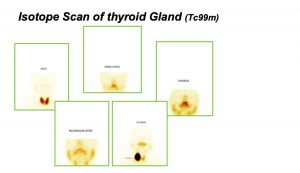
Radioiodine is used to assess the function of the thyroid gland. A small amount of the substance 2-5mCi (which will not affect the function of the gland) is given either as a pill or a tasteless liquid and images of the gland are taken afterwards.

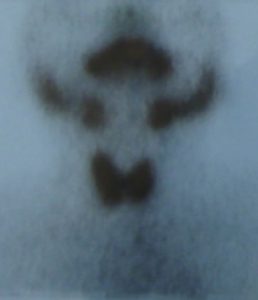
Normal thyroid glands take this uniformly and a small amount is also taken up by the Salivary glands. If the substance is avidly taken up by the thyroid gland, then whole of the thyroid gland is seen very prominent and salivary glands do not get an opportunity to take up any iodine. This is called overactive thyroid.

A small area may pick up whole of the iodine and rest of the gland does not get a chance because the small area is overactive, this is called cold HOT nodule, a hot nodule is almost never cancer. It may happen that whole of the thyroid picks up iodine other than a small area, this is called COLD nodule. Up to 10% of the cold nodules can be malignant.

Sometimes the results are confusing when in spite of high levels of Thyroid hormones, the scan can show decreased uptake and this is called Thyroiditis. We can expect five different kinds of reports – Normal uptake, diffusely increased uptake (Graves’ disease), Hot nodule, Cold nodule and Thyroiditis.

radio_1

Decreased uptake Thyroiditis

radio_2

Cold nodule with decreased uptake in left upper lobe


radio_3

Hot nodule with increased uptake  in left lobe

radio_41

Diffusely increased uptake – Graves’ disease

radio_51

Decreased uptake Thyroiditis

Pregnancy and Thyroid

Is thyroid important in pregnancy?

Yes, it is. A normal thyroid is needed for regular egg production. Very low thyroid in man also can effect sperm production. This is the reason why thyroid function test is included in the investigation of infertility.

Again a normal thyroid state is needed for maintenance and continuation of pregnancy. The incidence of miscarriage is high with low or high thyroid.

How do we treat under active thyroid in pregnancy?

Treatment is actually very simple. If diagnosed to have under-active thyroid, treatment should be started immediately. Mother’s under-active thyroid may affect the baby in the tummy in different ways. This is a sort of natural treatment, replacing the deficient hormone. We now prepare in the laboratory same thyroid hormone (same chemical nature) that is produced by our thyroid gland, so the chance of reaction or not tolerating is not there. You need to take the tablet regularly in empty stomach and in the correct dose.

Remember iron and calcium tablet do not allow thyroid tablet to get absorbed from the stomach. You will be taking are iron and calcium tablet in pregnancy, there should be a gap of four hours between thyroid tablet and iron/calcium.

What is the correct dose?

There is no correct dose; we need to give you the dose your body needs. Remember, you dose of thyroid medicine will go up in pregnancy, because for the growing baby the demand is more. So, we need blood check in pregnancy a bit more frequently.

Treatment of Overactive Thyroid in pregnancy

Treatment of overactive thyroid is always with tablet that suppresses the thyroid gland (Carbimazole and Propylthiouracil). Radioiodine is NOT to be given in pregnancy. If we can not manage with tablets, we might have to proceed to surgery, that is taking the thyroid gland out. This is actually very rare.

Can I plan pregnancy when I am on thyroxine tablet?

Safely you can. As we have told, the structure of the thyroid hormone in our body and that of the thyroid tablet is the same, so there is no chance of baby getting problem of any sort. Also, another information of comfort is thyroid hormone does not cross the placenta meaning it does not reach baby. Commonly, pregnant ladies stop treatment because of the fear but stopping can be very harmful and can end up with termination of the pregnancy. The dose requirement of thyroid tablet in pregnancy goes up simply because demand increases. Hence it is recommended to have thyroid tests done at least three-times during pregnancy. Also a fine tuning of the dose is required in pregnancy for normal growth of the baby.

Can I plan pregnancy with overactive thyroid?

You can safely plan for pregnancy if you have overactive thyroid but it is best to sort out thyroid problem before conception if possible. If you have received radioactive iodine, you should not conceive within four months of treatment. We start medical treatment with tablet if you have been diagnosed to have overactive thyroid for the first time in pregnancy and control the thyroid function. This time you may require frequent testing of the blood, may be once a month. Also we monitor baby’s growth carefully by ultrasound. Baby getting a problem of thyroid if mother has overactive thyroid is rare and we can not predict. So it is better not get worried and follow the suggestion of your Obstetrician and Endocrinologist.

Subclinical hypothyroidism

What is subclinical hypothyroidism?

This is an entity when the TSH has just gone up above normal to usually less than 10miu/ml and the thyroid hormones are on the lower side of the normal range. You are unlikely to have symptoms of Hypothyroidism here, so this is called subclinical or boderline Hypothyroidism.

What are the causes?

The same causes that can cause hypothyroidism are responsible for subclinical hypothyroidism, this is actually a stage from normal to proper Hypothyroidism.

Do we need to treat this condition?

Usually this condition does not warrant treatment except in certain select situations like:

  • Children
  • Pregnant women
  • Women planning conception
  • Other intercurrent illness requiring hospitalisation
  • Before any surgical procedure
  • Women with menstrual problems.

What is the course?

If not started on treatment, then we can wait and observe the thyroid function again after 2-3 months. It can resolve on its own, persist as subclinical hypothyroidism or proceed to frank hypothyroidism.

Treatment of Low and High Thyroid

Treatment of under active Thyroid (Hypothyroidism)

This is a sort of natural treatment, replacing the deficient hormone. We now prepare in the laboratory same thyroid hormone (same chemical nature) that is produced by our thyroid gland, so the chance of reaction or not tolerating is not there. You need to take the tablet regularly in empty stomach and in the correct dose.

Remember iron and calcium tablet do not allow thyroid tablet to get absorbed from the stomach. So, if you are on iron or calcium tablet, there should be a gap of four hours between the two.

Treatment of Overactive Thyroid (Hyperthyroidism)

Initial treatment of overactive thyroid is always with tablet that suppresses the thyroid gland (Carbimazole and Propylthiouracil). They are safe but very rarely can reduce the blood count and which will make you prone for infections, particularly throat infection. So, when you develop sore throat, you should stop the tablet immediately and see your doctor for a blood count. The rest will be done by your doctor.

The next part of treatment depends why the thyroid is overactive. If you have one or more nodule/s that/those is/are overactive, Radioiodine treatment is better. As thyroid is the gland in the body which handles iodine, radioiodine enters the thyroid gland and destroys the overactive areas. The dose we use does not damage other organs. Sometime, your thyroid may become under active after radioiodine and that can be easily treated with thyroid hormone, as above.

The treatment can be continued for a long period depending on the response. After giving a trial for 12-18 months, we stop and see how your thyroid behaves. If it becomes overactive again, we can either restart the tablets or give radioactive iodine. These days with improvement in monitoring facility and availability of anti-thyroid medicines and radioiodine, we rarely require operation to remove the overactive thyroid gland.

How long to continue treatment?

Overactive thyroid: We try medical treatment for around 12-18 mths, if not controlled we prefer radioactive iodine. With the advancement of medical science, surgery is very rarely required as a treatment of overactive thyroid.

Under active thyroid: While you are on treatment with thyroid hormone, it is not possible to tell how much of the thyroid hormone in blood is coming from the tablet and how much from the gland because the thyroid hormone we give now is exactly the same in chemical structure as that of the body’s own thyroid hormone. The only way is to stop your tablet for six weeks and repeat the blood test. If you are genuinely under active, your symptoms will come back and you should understand that your own thyroid gland is unable to give you normal amount of thyroid hormone and you need to supplement from outside. This type of trial of stopping and watching is usually recommended only once 12 to 18 months after starting treatment in adults and after 2 years in children.

Low and High Thyroid

What is Hypo- and Hyper-thyroidism?

Under-active thyroid means your thyroid gland is unable to provide normal amount of thyroid hormone. In the same way, if the gland keeps on producing more thyroid hormone than normal, it is called over-active thyroid.

Hypo means under active: Hyper means overactive

What are the symptoms of Thyroid diseases?

The common symptoms of under active and overactive thyroid are as shown in the box below. Irregularity of periods and difficulty in having baby can be seen in women with both under- and over-active thyroids.

Overactive – Hyperthyroidism

Under active – Hypothyroidism

Irritable/ Excitable

Weight loss/ Weakness

Diarrhoea

Rapid heart rate

Feeling too warm

Hyperactivity in children

Slow/ Sleepy

Weight gain/ Fluid retention

Dry skin/ Hair loss

Constipation/ Slow heart rate

Feeling too cold

Poor growth in children

 Page 1 of 2  1  2 »